Staking networks often connect economic security and governance. Validators operate infrastructure and hold delegated stake, while token holders may vote directly or allow their validator’s position to represent them. Proposals can change network parameters, fund community initiatives, authorize upgrades, or signal support for broader policy. Because consensus and governance both involve validators and stake, it is easy to treat them as the same process. They are related, but they authorize different things and carry different risks.
Consensus voting and governance voting are different
Consensus voting helps a network agree on blocks and state. Validators propose or attest to blocks according to the consensus protocol, and faulty behavior may be penalized through slashing or loss of rewards. Governance voting considers explicit proposals outside the ordinary block-production decision. A validator can perform consensus duties reliably while taking controversial governance positions, or participate in governance while operating weak infrastructure.
Keeping the distinction clear improves accountability. Uptime, double-signing, and protocol compliance are operational metrics. Proposal participation, rationales, and conflicts are governance metrics. Delegators may care about both, but a single score can hide tradeoffs between them.
How staking creates voting weight
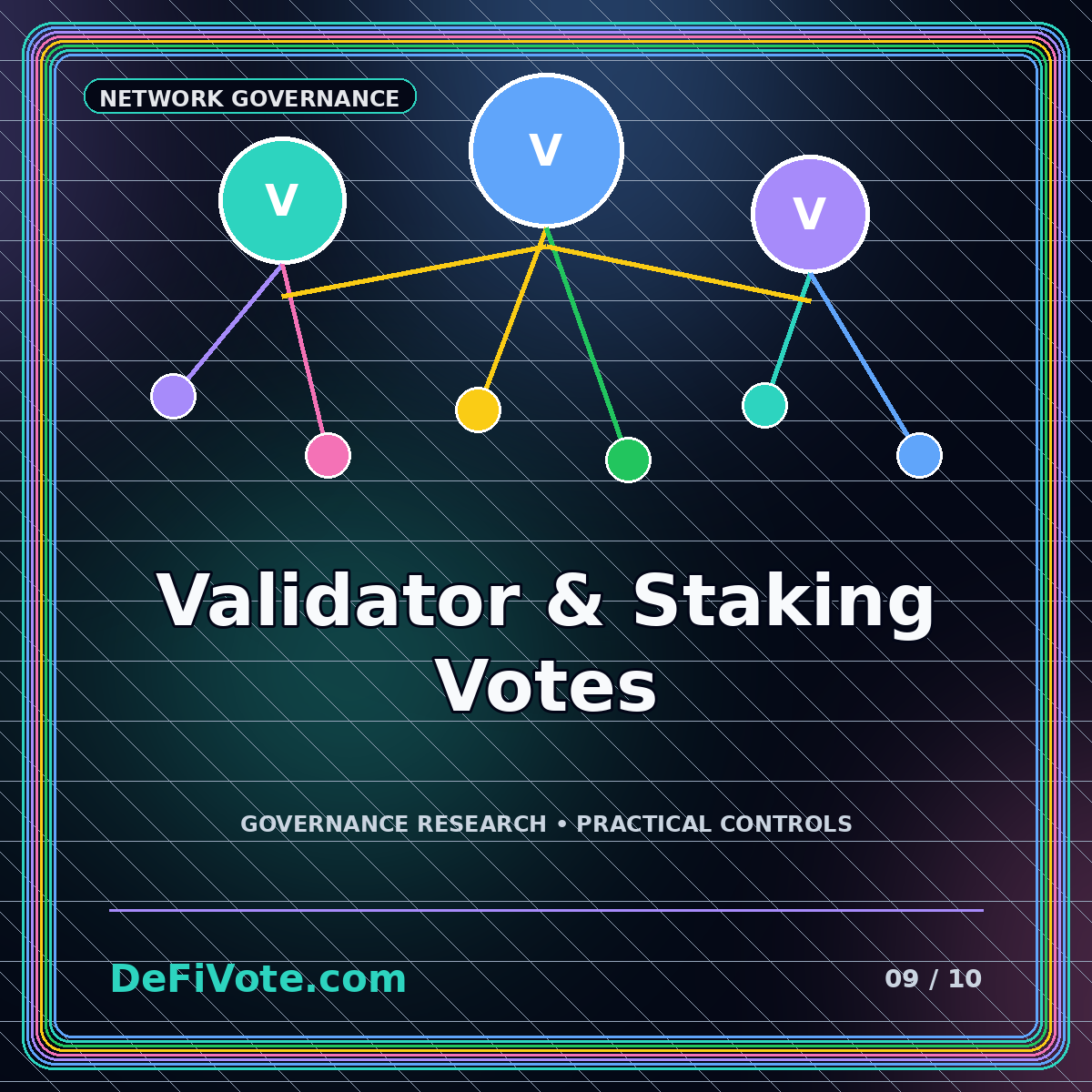
In many proof-of-stake systems, governance power is proportional to bonded or staked tokens. A validator’s apparent voting weight may include self-stake and tokens delegated by others. The system must decide whether delegators automatically inherit the validator’s vote, can override it with a direct ballot, or vote independently from the start.
The Cosmos SDK governance module specification describes an on-chain process with proposal submission, deposits, voting, and tallying, including a model where delegators can inherit a validator’s vote if they do not vote themselves. This structure reduces the cost of passive participation while preserving a path for direct override. It also makes validator governance behavior relevant to delegation choices.
Proposal deposits and agenda control
Some staking-governance systems require a deposit before a proposal enters the voting period. The deposit can deter spam and demonstrate preliminary support. Contributors may combine deposits until the minimum is reached. Rules then determine whether deposits are refunded, burned, or partially retained based on the outcome.
Deposit design affects access. A high minimum can make proposals dependent on validators, foundations, or wealthy holders. A low minimum may fill the ballot with low-quality items. Communities can supplement deposits with discussion requirements, proposal templates, sponsorship, or separate tracks for text, parameter, spend, and software-upgrade proposals.
Voting options and veto power
Staking governance often includes choices such as yes, no, abstain, and no-with-veto. Abstain can count toward quorum while declining to choose a side. A veto option may signal that a proposal is malicious, invalid, or harmful enough to justify an additional consequence such as burning deposits. The exact tally formula matters: thresholds may use total bonded stake, participating stake, or votes excluding abstentions.
Interfaces should explain the mathematical effect of each option. Participants may believe abstain is neutral when it helps satisfy quorum, or use veto as a stronger form of ordinary opposition even though the protocol gives it special consequences. Governance education is part of mechanism security.
Validator influence and delegator agency
Vote inheritance gives validators substantial default influence because many delegators will not vote on every proposal. That can be efficient, but it creates a responsibility to publish positions and rationales before the voting period ends. Delegators need enough time to override a vote they reject. A validator who remains silent can exercise large power without giving supporters a meaningful choice.
Delegators should evaluate governance behavior alongside commission and uptime. Does the validator disclose conflicts? Does it vote consistently with stated principles? Does it participate in discussion or merely follow large peers? Re-delegation provides accountability, but unbonding periods, tax effects, custody arrangements, and concentration can make exit less immediate than the governance theory suggests.
Concentration risks in staked governance
Stake naturally concentrates around validators with strong brands, exchange distribution, or long operating histories. Centralized custodians may aggregate the voting rights of many users. If the largest validators vote together, they can determine outcomes even when token ownership is broad. This is a political and infrastructure risk: the same entities may influence consensus, governance, and user access.
Useful analytics include the stake controlled by the top validators, the coalition required to meet quorum, direct delegator overrides, and the share held by custodial services. Caps and redelegation incentives can reduce concentration, but forced fragmentation may create related operators under different names. Transparency of ownership and control is as important as address-level distribution.
Software upgrades require social coordination
A governance vote can approve a software upgrade, but validators still need to install and run compatible code at the designated height or time. The proposal should identify the release, checksum, migration behavior, testnet results, rollback considerations, and communication plan. A passed vote without operational readiness can halt the network or split participants across incompatible versions.
Upgrade governance therefore crosses the boundary between authorization and coordination. Core developers prepare code, auditors and operators test it, validators schedule maintenance, infrastructure providers update dependencies, and users monitor the result. The on-chain proposal is a focal point, not the entire implementation process.
Community pools and spending proposals
Staking networks may collect funds in a community pool and distribute them through governance. The same treasury principles that apply to DAOs remain relevant: clear recipient identity, scope, milestones, conflicts, payment schedule, and reporting. Token holders should distinguish spending that improves the network from spending that mainly subsidizes private activity.
Because inflation or protocol fees may replenish the pool, participants can underestimate opportunity cost. Every allocation reduces the resources available for security research, infrastructure, public goods, or future emergencies. Reporting should show both the payment and the outcome.
Governance and slashing
Slashing is typically designed for objectively detectable consensus faults such as double-signing or extended downtime, not for an unpopular governance vote. Expanding slashing to political choices can suppress independent judgment and make validators follow the expected majority. Governance accountability is usually better handled through delegation movement, reputation, compensation, or explicit constitutional rules.
There may still be consequences for violating procedural duties, such as failing to disclose a conflict under a validator program. Those consequences should be defined in advance and separated from base-layer consensus penalties. Ambiguous punishment makes governance less predictable and can encourage abstention.
How to evaluate a staking-governance system
- Identify which staked balances count and when voting power is measured.
- Determine whether delegators inherit, override, or independently cast votes.
- Review deposit, quorum, approval, abstain, and veto rules.
- Measure validator and custodian concentration.
- Inspect the process for software upgrades and emergency coordination.
- Track validator rationales and delegator override behavior.
- Verify how community-pool spending is implemented and reported.
Communication and voter tooling
Staking governance is easier to participate in when wallets and explorers show proposal status, validator positions, inherited votes, and the deadline for a delegator override. Notifications should distinguish consensus incidents from governance events and explain any transaction fee or unbonding implication. Clear tooling reduces accidental abstention and makes representative behavior visible before, rather than after, a proposal closes.
Networks should also preserve proposal text, software references, tally inputs, and execution evidence in durable archives. Governance history becomes operational knowledge for future upgrades and helps new validators understand why parameters exist. A chain that stores the vote but loses the reasoning retains only part of its decision record.
Conclusion
Validator voting connects network operation, delegated stake, and collective decision-making. Its strength is that governance can use the same economic relationships that secure the chain. Its risk is that default representation and stake concentration can give a small set of operators broad influence. Clear inheritance rules, direct delegator overrides, transparent validator positions, and disciplined upgrade coordination help the system turn staked power into accountable governance rather than automatic control.
Continue exploring DeFi governance
Build context with the DeFi governance guide, voting systems guide, and vote delegation design.