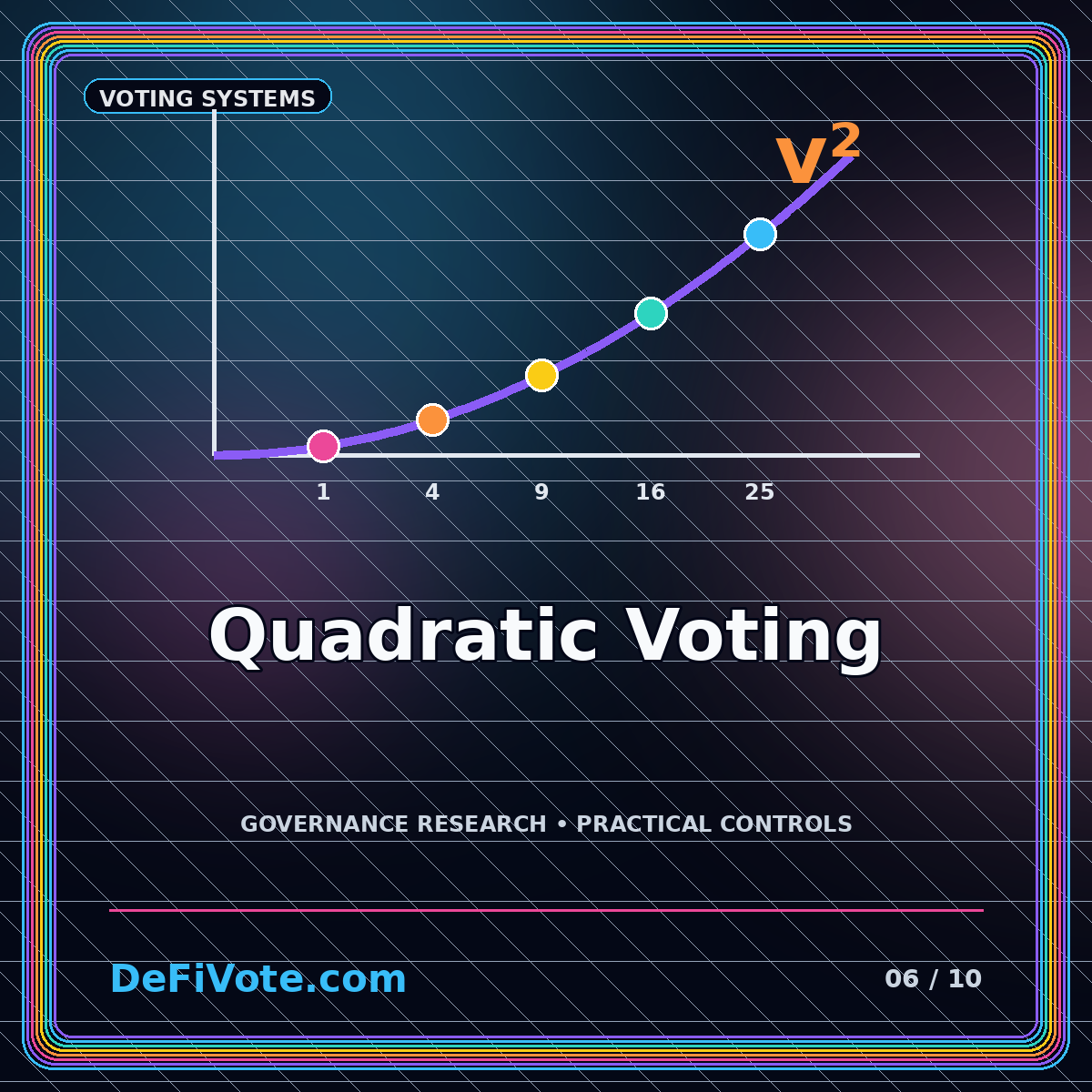
Quadratic voting is a collective-choice mechanism designed to let participants express not only which option they prefer but how strongly they prefer it. Instead of giving every participant one ballot or making influence grow linearly with tokens, the cost of additional votes rises quadratically. Casting one vote costs one credit, two votes cost four credits, three votes cost nine, and so on. The curve makes modest support affordable while making concentrated influence progressively more expensive.
The basic quadratic rule
If a participant casts v votes on an option, the cost is commonly represented as v² credits. The relationship can also be read in reverse: with a budget of 100 credits, a participant could place ten votes on one issue, or distribute credits across several issues. Because the tenth unit of influence costs more than the first, the mechanism encourages voters to reserve large allocations for decisions they care about most.
| Votes on one option | Credit cost | Marginal cost of next vote |
|---|---|---|
| 1 | 1 | 3 more credits to reach 2 |
| 2 | 4 | 5 more credits to reach 3 |
| 3 | 9 | 7 more credits to reach 4 |
| 5 | 25 | 11 more credits to reach 6 |
| 10 | 100 | 21 more credits to reach 11 |
The relevant unit does not have to be money. Many community implementations distribute nontransferable voice credits for a round. Participants spend those credits to support or oppose options. The budget creates scarcity, while the quadratic price makes it costly to dominate every choice.
Why preference intensity matters
Simple majority voting captures direction but not intensity. Fifty-one voters who weakly prefer an option can defeat forty-nine voters for whom the decision is extremely important. Token-weighted voting captures stake, but it may treat wealth as a proxy for all relevant interest. Quadratic voting attempts to reveal intensity by asking participants to sacrifice more of a limited budget when they want more influence.
The formal motivation is explored in the quadratic voting work by Steven Lalley and E. Glen Weyl. In practical DAO settings, the attraction is intuitive: a broad community can express light support across many items, while groups deeply affected by one proposal can concentrate credits without receiving unlimited linear power.
A simple DAO example
Imagine a DAO allocating a grants budget across developer tooling, education, security research, and local events. Each verified participant receives 100 voice credits. Alice cares strongly about security and spends 64 credits for eight security votes, then uses the remaining 36 credits for six tooling votes. Bob divides his budget more evenly, placing five votes on each of four categories for a total cost of 100 credits.
This ballot says more than a single-choice vote. Alice communicates a strong priority while still expressing a secondary preference. Bob communicates balanced support. The final tally aggregates votes, not credits, so the expensive concentrated allocations carry additional influence without allowing a participant to convert every credit into one linear vote.
Potential benefits for DAOs
More expressive budgeting
Quadratic voting is well suited to choices involving several competing priorities. Grants rounds, roadmap prioritization, contributor elections, and participatory budgeting can benefit from ballots that let voters distribute attention. The output can reveal which items have broad shallow support and which have narrower but intense support.
Reduced dominance from linear balances
When voice credits are allocated per verified participant rather than purchased with governance tokens, the mechanism can reduce the direct influence of wealth. Even when budgets are stake-informed, the quadratic cost can make additional control more expensive than a one-token-one-vote rule. The effect depends entirely on how budgets are assigned.
Incentives to prioritize
A fixed credit budget forces tradeoffs. Voters cannot maximize support for every attractive proposal. They must decide where another vote is worth its rising marginal cost. This can produce more informative results than approval voting when a long list of proposals is individually acceptable but funding is limited.
The identity and Sybil problem
Quadratic costs assume that one participant cannot cheaply split into many identities. If an individual with 100 credits can create four accounts with 100 credits each, the mechanism’s influence limits collapse. The attacker gains multiple low-cost first votes rather than paying the higher marginal cost associated with one identity. This is the central operational challenge for person-based quadratic voting.
Possible defenses include proof-of-personhood systems, membership registries, contribution credentials, stake requirements, attestations, or manual review. Each adds tradeoffs involving privacy, access, exclusion, and administration. Token-based identity avoids some Sybil risk because splitting a fixed token balance does not necessarily create more voting budget, but it may reintroduce wealth concentration. The identity model must be designed before the vote curve, not treated as an implementation detail.
Collusion and credit markets
Participants may coordinate allocations, trade favors, or sell control of their ballots. Nontransferable credits prevent direct transfers but cannot stop off-platform agreements. Public ballots can make bribery verifiable, while private ballots can reduce accountability and complicate auditability. No mechanism fully removes social coordination; the goal is to understand which forms of coordination are acceptable and which undermine the decision.
Communities can limit incentives for collusion by keeping rewards independent of voting behavior, using conflict disclosures, and avoiding mechanisms where a small group can extract a direct financial benefit at everyone else’s expense. For high-value treasury decisions, quadratic voting may be better as a signaling or prioritization layer followed by additional review.
Budget allocation is a governance choice
The quadratic formula receives attention, but the allocation of voice credits often determines the distributional outcome. Equal credits per verified person emphasize individual membership. Credits based on contribution recognize work but require a trusted scoring process. Credits based on tokens preserve economic stake but can reproduce concentration. A hybrid formula may combine a baseline allocation with bounded stake or reputation factors.
Designers should publish the budget rule, eligibility period, expiration, and whether unused credits carry forward. Carryover can reward long-term planning but lets participants accumulate influence for a future vote. Round-specific credits are simpler and make each decision cohort explicit.
When quadratic voting is a good fit
- Several options compete for a limited budget or ranked priority.
- The community wants to measure intensity, not only yes-or-no direction.
- Eligibility and duplicate-identity controls are credible for the decision’s value.
- The result is advisory or has a separate execution and security review.
- Participants can understand the credit interface and review their total cost.
It is a weaker fit when a proposal contains a single irreversible contract action, identity is easy to duplicate, or the community cannot explain how credits were distributed. For protocol upgrades, a conventional on-chain governor with clear quorum and timelock controls may be easier to audit and defend.
Implementation checklist
Define the decision scope first. Then choose the identity model, credit budget, positive and negative vote rules, privacy level, tie handling, and execution path. Test the interface with realistic scenarios; quadratic arithmetic can confuse users who expect a linear slider. Show the cost of the current allocation, the marginal cost of another vote, and the credits remaining.
Publish the tally method and raw ballots in a form that independent observers can verify, subject to any privacy design. Run simulations for strategic behavior and test whether splitting identities, coordinating accounts, or focusing all credits produces unexpected outcomes. After the round, compare the result with participant feedback and actual project performance.
Conclusion
Quadratic voting offers a useful way to express preference intensity and allocate scarce attention across multiple choices. Its curved cost can moderate concentrated influence, but the mechanism is only as credible as its identity system, credit allocation, and resistance to collusion. DAOs should treat it as a design toolkit rather than a universal upgrade to majority voting. Used for the right decision, with transparent budgets and careful eligibility, it can reveal priorities that simpler ballots miss.
Continue exploring DeFi governance
Build context with the DAO voting systems, delegation guide, and on-chain vs off-chain comparison.