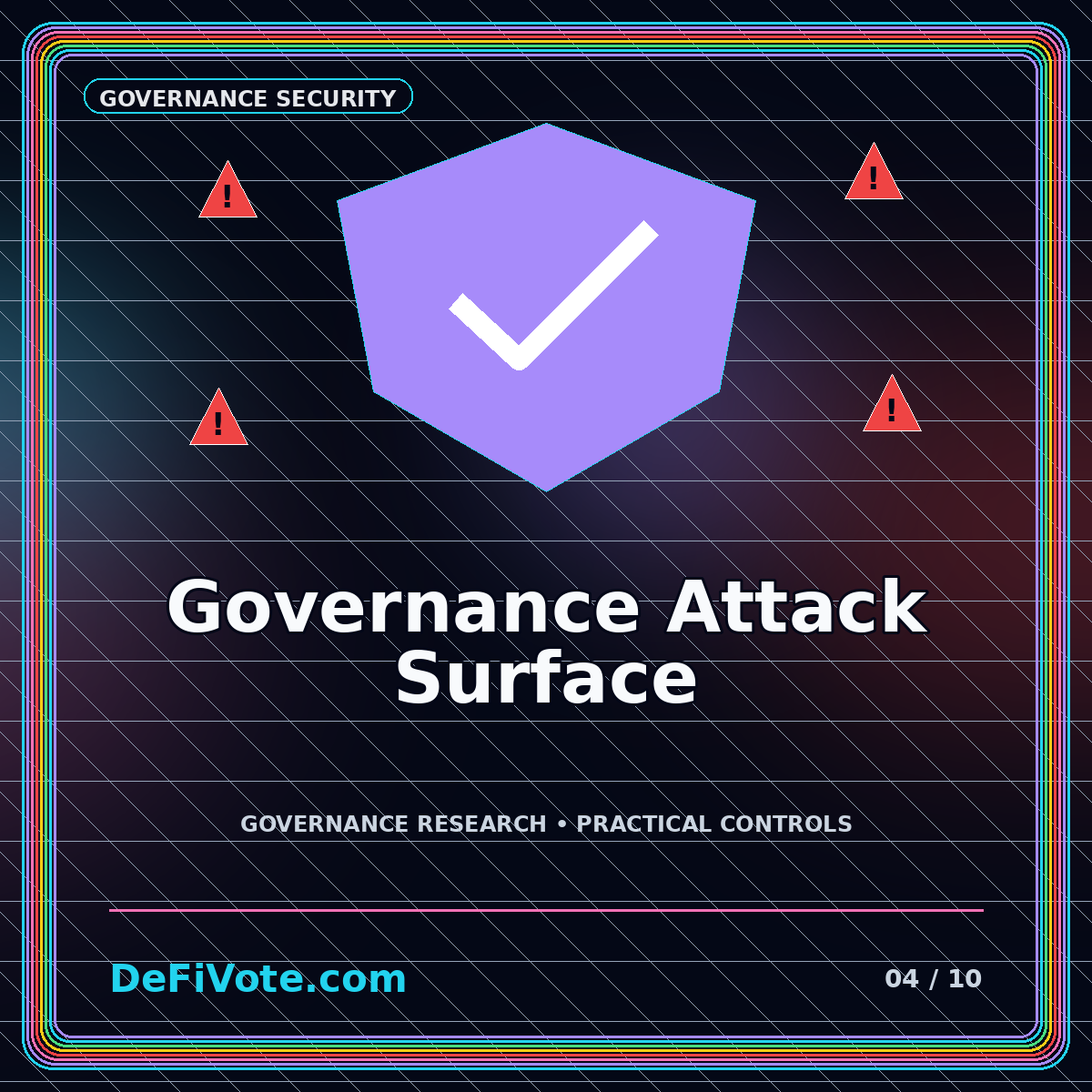
A governance system is an administrative control plane for valuable contracts and treasuries. That makes it a security boundary, not merely a community feature. An attacker does not always need to exploit protocol code directly; gaining enough voting power, manipulating a low-turnout process, hiding a malicious action inside a proposal, or compromising an execution role may produce the same result. A useful threat model therefore follows authority from voting-power creation through proposal execution and asks how each step could be captured, confused, or bypassed.
Start with the assets and powers at risk
Threat modeling begins by inventorying what governance can do. Common powers include upgrading implementations, changing oracle sources, adjusting collateral or fee parameters, listing assets, transferring treasury funds, appointing guardians, changing bridge endpoints, and modifying governance itself. The highest-risk powers are those that can move assets, disable safety checks, or create new authority with a single proposal.
Map each power to the contracts and accounts that hold it. A public governor may control some functions while a multisig retains others. A timelock may be the nominal administrator, but a proxy admin, bridge receiver, pause guardian, or emergency council may have independent capabilities. Security analysis should reflect the actual permission graph, not the organization chart shown in community materials.
Economic attacks on voting power
Token-weighted governance assumes that voting power reflects a durable stake in the protocol. That assumption weakens when votes can be borrowed, rapidly acquired, or coordinated without equivalent exposure to the consequences. A flash loan is the most recognizable example, but the broader issue is temporary influence. Lending markets, derivatives, custody platforms, and cross-chain wrappers can separate economic ownership from the address that appears eligible to vote.
Historical snapshots and delegated checkpoints reduce repeated use of the same tokens and can require power to exist before a proposal becomes active. Proposal thresholds, voting delays, and timelocks increase the time and capital an attacker must commit. These controls do not eliminate capture by a wealthy actor or coalition. Communities should monitor concentration, exchange-controlled balances, inactive delegations, and the cost of reaching both proposal and quorum thresholds.
Low-turnout and timing attacks
An attacker may not need majority ownership if most eligible power is inactive. Proposals submitted during holidays, market stress, or competing protocol events can receive less review. A short voting period, weak notifications, or fragmented communication makes this easier. Agenda control can become a security vulnerability when only a few participants monitor proposal creation continuously.
Defenses include predictable review windows, minimum discussion periods, clear proposal calendars, and alerts triggered directly from contract events. Quorum helps, but a static quorum can still be too low relative to current delegation. Participation thresholds should be reviewed alongside the percentage of voting power controlled by the largest delegates. A proposal that technically meets quorum may still depend on one address.
Proposal-content attacks
A proposal can be malicious even when the title and forum summary sound ordinary. Executable governance often bundles target addresses, function selectors, values, and encoded parameters that are difficult for non-specialists to read. An attacker may exploit that complexity by adding an extra transfer, granting a role, switching an implementation, or using a contract whose behavior changes before execution.
Every executable action should be decoded into plain language and linked to verified source code where possible. Reviewers should compare the human description with the exact call data, inspect proxy relationships, and simulate the complete action set against a recent state. Proposals that contain dynamic targets, delegate calls, arbitrary execution modules, or upgrades deserve additional scrutiny because their effects may extend beyond the visible function name.
Timelock and execution risks
A timelock creates time to detect and respond to a harmful proposal, but its configuration can introduce weaknesses. The delay may be too short, the proposer or executor roles may be overly broad, cancellation authority may be compromised, or queued operations may remain executable indefinitely. A governance system also needs a realistic response path: a delay provides little protection if no one can cancel, pause, exit, or coordinate an upgrade before execution.
The Compound governance documentation illustrates how a governor and timelock can control protocol administrative functions, including multi-chain components. This is a reminder that execution security extends beyond the vote contract. Bridge receivers, local timelocks, proxy administrators, and chain-specific deployments must preserve the same authorization assumptions or clearly document where they differ.
Multichain governance expands the boundary
When a main-chain vote controls deployments on other networks, the decision passes through messaging infrastructure. The destination chain must verify the origin, message, ordering, and replay status. A compromised bridge, incorrectly configured receiver, or mismatched delay can turn a legitimate main-chain decision into an unsafe destination action. Governance teams should inventory every hop and test failure behavior, not only the happy path.
Cross-chain execution also complicates incident response. One chain may receive a message before another, creating temporary inconsistency. A rollback may be impossible if the destination action is irreversible. Proposals should describe sequencing, chain-specific owners, confirmation requirements, and what happens if only part of a multi-chain package succeeds.
Social and procedural capture
Not all attacks violate contract rules. A coalition can dominate the forum, suppress alternatives, rush a vote, or present a false sense of consensus. Delegates may have undisclosed financial relationships with proposers or service providers. A foundation may control communication channels and decide which proposals receive legal or technical support. These forms of capture are harder to detect because the final ballot can still be valid.
Process defenses include conflict disclosures, proposal templates, independent review grants, transparent moderation rules, and a minimum period between material edits and voting. Delegates should publish rationales and identify when they rely on third-party analysis. Communities should preserve dissenting views in the proposal record rather than treating debate as an obstacle to execution.
Key compromise and privileged-role risk
Governance security depends on the wallets that create, cancel, queue, execute, pause, or administer contracts. A well-designed voting rule can be bypassed if a privileged key is stolen. Multisignature thresholds reduce single-key risk, but signer selection, device security, geographic distribution, backup procedures, and replacement rules still matter. Signers should understand whether they are exercising discretion or merely attesting that a governance condition was met.
Privileged roles should be minimal and separately monitored. The ability to pause does not require the ability to upgrade. The ability to cancel a malicious proposal does not necessarily require the ability to create one. Time-limited roles, scoped permissions, and public event alerts reduce the damage from compromise and make emergency authority more accountable.
Monitoring and incident response
Governance monitoring should cover proposal creation, large delegation changes, quorum concentration, role grants, timelock queues, cancellations, and executions. Alerts need human owners and escalation paths. A notification that no one is responsible for reviewing is not a control. High-risk events should trigger payload decoding, simulation, and verification against the published proposal.
An incident plan should define who can pause affected functions, how the community is informed, which channels are authoritative, and what evidence is required to cancel or delay an action. Practice matters. Tabletop exercises can reveal that a security council lacks a signer, a timelock delay is misunderstood, or key participants cannot coordinate across time zones.
A governance-security checklist
- Map every contract and account with upgrade, treasury, pause, or role-management authority.
- Measure the cost of reaching proposal threshold, quorum, and approval under realistic liquidity conditions.
- Use historical voting-power checkpoints and review delegation changes before major proposals.
- Decode and simulate all executable actions, including nested calls and proxy upgrades.
- Test timelock, cancellation, expiry, and emergency procedures.
- Review cross-chain message paths and destination permissions.
- Publish conflict disclosures and preserve proposal revision history.
- Monitor privileged roles and maintain a rehearsed incident-response plan.
Conclusion
DAO voting security is the security of the entire authority pipeline. Economic ownership, delegation, proposal timing, call data, timelocks, bridges, privileged wallets, and social process can each become an attack surface. The objective is not to make governance impossible to change; it is to make harmful change expensive, visible, delayed when appropriate, and recoverable where possible. Protocols that treat governance as production infrastructure are better positioned to protect both decentralization and the assets that decentralization is meant to control.
Continue exploring DeFi governance
Build context with the governance authority guide, governance analytics, and treasury governance workflow.